
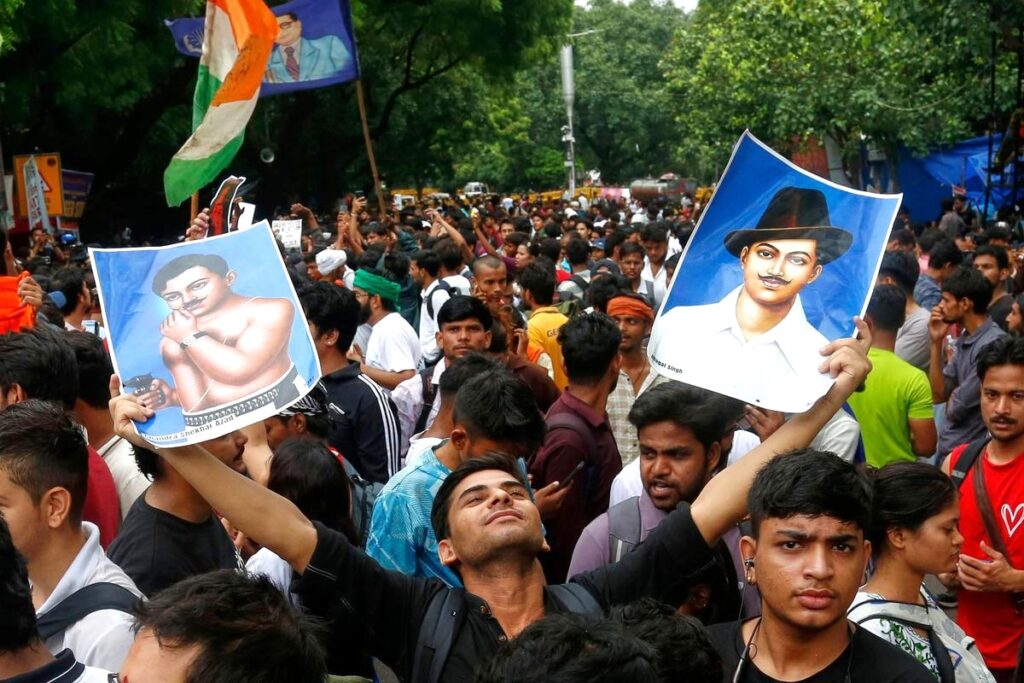
In today’s rapidly evolving communication landscape, the relationship between people, media and movements is changing fundamentally.
Public communication is no longer driven exclusively by newspapers, television, press conferences or large-scale outdoor campaigns. Increasingly, conversations are born on smartphones, shaped by memes and short-form videos, amplified through social networks and eventually translated into action on the ground.
The recent rise of the Cockroach Janta Party (CJP) and the mobilisation around the Jantar Mantar protests provides an interesting case study of this emerging communication paradigm.
Regardless of one’s political position or perspective on the movement, the phenomenon presents several noteworthy lessons from a Communication and Outreach standpoint—particularly around Gen-Z engagement, participatory branding, digital community building, social media amplification and online-to-offline mobilisation.
At the heart of this phenomenon is a communication journey that can be broadly represented as:
Meme → Symbol → Identity → Community → Digital Mobilisation → Physical Participation → Media Amplification
This article looks at the phenomenon not as a political endorsement, but as a communication case study to understand how contemporary movements can use digital culture to capture attention, build identity and create public conversations.
1. Communication Begins with Cultural Relevance
One of the most interesting aspects of the CJP phenomenon is the use of an unconventional symbol—the cockroach.
Traditional communication campaigns often rely on carefully designed logos, formal messaging and polished brand identities. In contrast, internet-native communities frequently build identity around symbols that emerge from popular culture, humour or shared experiences.
The cockroach, in this context, became more than a visual element.
It became a potential metaphor for:
- Resilience
- Survival
- Persistence
- Frustration
- Resistance
- The ability to “keep going”
The communication lesson here is significant.
A message becomes more powerful when audiences can see themselves in it.
For Gen-Z audiences, humour and satire often serve as entry points into serious conversations. A humorous symbol can make a complex issue feel more accessible, relatable and shareable.
From a communication perspective, this represents a shift from message-led communication to culture-led communication.
2. From Traditional Campaigns to “Meme-to-Movement” Communication
Traditional public outreach often follows a linear model:
Message → Media → Audience → Response
Digital movements increasingly operate through a more circular ecosystem:
Content → Sharing → Community → Participation → New Content → Wider Sharing
This creates what may be described as a “Meme-to-Movement” communication model.
A meme may initially attract attention because it is humorous.
A Reel may be shared because it is relatable.
A visual symbol may be adopted because it creates a sense of belonging.
Over time, these individual actions can contribute to the formation of a digital community.
The important insight for communication professionals is that not every audience interaction begins with a formal call to action.
Sometimes, engagement begins with something as simple as:
“This is funny.”
It can then progress to:
“This is relatable.”
Then:
“This represents how I feel.”
And eventually:
“I want to be part of this conversation.”
This transition from attention to identification is one of the most powerful mechanisms in contemporary digital outreach.
3. Instagram as a Community-Building Platform
The growth of the CJP digital presence highlights the importance of Instagram and short-form content platforms in reaching younger audiences.
The platform is not simply being used as a broadcasting channel.
It functions simultaneously as:
- A media platform
- A community space
- A branding environment
- A mobilisation tool
- A feedback mechanism
- A content distribution network
Reports during the movement’s early growth phase suggested rapid increases in the account’s Instagram following, with some reports citing millions of followers within a matter of days. Later third-party analytics have reported substantially higher figures, although such numbers should be treated as indicative rather than independently audited.
From a communication perspective, however, the exact follower count is less important than the velocity of audience acquisition.
The key question is:
What made people follow, share and participate so quickly?
One answer lies in the content’s alignment with the behaviour of digital-native audiences.
Short-form videos, memes, visual humour and easily recognisable symbols are inherently suited to the way Gen-Z audiences consume and share information.
The result is a communication environment where:
Every follower can potentially become a distributor.
4. The Audience as the Communication Channel
One of the biggest changes in contemporary outreach is the transformation of the audience from a passive recipient into an active communication participant.
In traditional communication:
Organisation → Message → Audience
In participatory digital communication:
Organisation → Content → Audience → Remix → Share → New Audience
This is particularly visible in meme-driven movements.
When a supporter shares a meme or Reel, they are not simply consuming the content. They are helping distribute it to their own network.
The communication therefore becomes decentralised.
The organisation or movement may create the original content, but its reach is determined by how audiences interpret, adapt and redistribute it.
This is the essence of participatory communication.
For NGOs, social-impact organisations and public-awareness campaigns, this is an increasingly important principle.
The question is no longer simply:
“How many people did we reach?”
It is also:
“How many people were motivated to share, discuss, adapt or recreate the message?”
5. From Followers to Participants: The Digital Mobilisation Funnel
A large social-media following does not automatically translate into meaningful engagement.
The real communication challenge is converting:
Reach → Engagement → Identification → Participation → Action
The CJP phenomenon is interesting because it appears to have created simple identity markers that allowed audiences to move from observers to participants.
This is a powerful outreach principle.
The easier it is for someone to participate, the greater the possibility of participation at scale.
A digital audience member may begin by:
- Watching a Reel
- Sharing a meme
- Following an account
- Using a hashtag
- Adding a Story
- Joining an online community
Some may eventually move towards:
- Volunteering
- Attending an event
- Participating in a protest
- Creating their own content
The key communication insight is that mobilisation is rarely a single action.
It is a journey.
Successful outreach strategies create multiple entry points along that journey.
6. The Power of Symbol-Centric Branding
Another interesting communication feature is the emphasis on a recognisable symbol.
Traditional political and institutional communication often relies heavily on personalities.
Digital communities, however, can sometimes build stronger collective identities around symbols.
The cockroach became a form of visual shorthand.
A single symbol could potentially communicate:
“I understand the conversation.”
“I identify with this community.”
“I am part of this digital culture.”
This type of symbol-centric branding has significant communication value.
For brands and organisations, the lesson is not to copy the symbol itself, but to understand the principle behind it:
Strong communication identities are often built around simple, recognisable and emotionally meaningful ideas.
The most effective symbols are those that audiences can easily remember, reproduce and reinterpret.
7. When Offline Events Become Digital Content
The Jantar Mantar protests also illustrate how the distinction between online and offline communication is increasingly disappearing.
A physical event is no longer limited to the people present at the location.
It can simultaneously exist as:
- A physical gathering
- An Instagram Story
- A Reel
- A livestream
- A YouTube video
- A WhatsApp forward
- A news report
- A trending topic
This creates an online-offline communication loop:
Physical Event
↓
Participant-Generated Content
↓
Social Media Distribution
↓
Public Conversation
↓
Media Coverage
↓
Increased Visibility
↓
Further Participation
The event generates content.
The content generates attention.
The attention generates discussion.
The discussion generates further content.
This creates a self-reinforcing communication cycle.
For communication professionals, this is an important shift.
An event should no longer be planned only as an event.
It should also be designed as a content ecosystem.
8. Citizen-Generated Content and Distributed Storytelling
The smartphone has transformed every participant into a potential storyteller.
At a protest or public event, participants can create:
- Short interviews
- Live updates
- Personal experiences
- Crowd visuals
- Photographs
- Reels
- Testimonials
- Reaction videos
This creates a form of distributed storytelling.
Instead of a single organisation controlling the narrative, hundreds or thousands of participants contribute their own perspectives.
From an outreach perspective, this can dramatically increase the volume and diversity of communication.
However, it also introduces challenges.
Distributed communication can be:
- Inconsistent
- Difficult to moderate
- Vulnerable to misinformation
- Open to misinterpretation
Therefore, organisations seeking to adopt participatory communication models must balance authenticity with communication governance.
The lesson is not simply to let audiences create content.
It is to create an environment where audience participation can thrive while maintaining accuracy, responsibility and trust.
9. Pop Culture as a Gateway to Public Communication
The appearance of popular fictional characters and pop-culture references within protest environments is another example of how contemporary communication is evolving.
For Gen-Z audiences, the boundaries between:
- Politics
- Entertainment
- Memes
- Gaming
- Pop culture
- Social commentary
are often fluid.
This creates opportunities for communication campaigns to use culturally relevant references to make serious issues more accessible.
From a communication standpoint, pop culture can function as an attention bridge.
It helps audiences who may not initially engage with a serious issue enter the conversation through something familiar.
The broader lesson is that cultural relevance can increase message accessibility.
However, this must be handled carefully. Cultural references should support the communication objective rather than distract from it.
10. The FOMO Effect and Perceived Momentum
Digital visibility can also create a powerful psychological effect: Fear of Missing Out (FOMO).
When people repeatedly encounter:
- Protest videos
- Large crowd visuals
- Influencer discussions
- Viral Reels
- Memes
- News coverage
they begin to perceive that something significant is happening.
This perception can influence participation.
The communication cycle becomes:
Visibility → Perceived Momentum → Participation → More Visibility
This is particularly relevant for youth mobilisation.
The perception that “everyone is talking about it” can itself become a driver of engagement.
For communication campaigns, this highlights the importance of creating visible signals of participation.
When people can see others participating, they are often more likely to consider participating themselves.
11. The Role of Hashtags in the Communication Ecosystem
The CJP movement has been associated with hashtags and search terms including:
#CockroachJantaParty
#CJP
#JantarMantar
#GenZ
#GenZProtest
#StudentProtest
#ExamPaperLeak
#NEET
#YouthUnemployment
#DharmendraPradhan
#SonamWangchuk
However, it is important to recognise that hashtags alone do not create movements.
Hashtags help organise conversations.
They improve discoverability.
They make content searchable.
But symbols, stories and emotions create identification.
In that sense:
The hashtag helps people find the conversation. The content gives them a reason to stay.
For communication and outreach professionals, this distinction is critical.
A campaign should not be built around hashtags alone.
It should be built around a strong communication idea, with hashtags functioning as one component of the distribution strategy.
12. How a Localised Protest Creates National Digital Ripples
One of the most interesting questions from an outreach perspective is how a physical protest centred in Delhi can generate conversations across India.
The answer lies in multiple layers of communication.
The Attention Layer
Memes and short-form content reach people who may not actively follow political news.
The Identity Layer
A recognisable symbol creates a sense of belonging.
The Issue Layer
The conversation expands from a specific event to broader concerns.
The Participation Layer
Digital audiences begin engaging, sharing and potentially joining offline activities.
The Media Layer
Mainstream and digital media amplify the conversation.
The Network Layer
People outside Delhi begin discussing the movement in their own communities.
This is how a geographically concentrated event can become a national digital conversation.
What Communication Professionals Can Learn
The CJP phenomenon offers several broader lessons for communication and outreach practitioners.
1. Start with culture, not just communication
Understand how your audience speaks, jokes, shares and interacts.
2. Build identity, not just awareness
Awareness tells people about an issue.
Identity makes people feel connected to it.
3. Make participation easy
Create simple actions that allow audiences to participate at different levels.
4. Design for sharing
A message that cannot travel organically may struggle to achieve scale.
5. Build visual shorthand
A strong symbol can communicate faster than a paragraph.
6. Treat audiences as partners
Participatory communication is often more powerful than one-way broadcasting.
7. Connect online and offline engagement
Digital campaigns and physical activities should reinforce each other.
8. Make events content-ready
Every event should have opportunities for storytelling, documentation and digital amplification.
9. Understand platform behaviour
A message should be adapted to the culture of the platform where it is being communicated.
10. Balance virality with credibility
Attention is valuable, but trust is more valuable.
The ability to go viral should never come at the cost of accuracy, responsibility or public trust.
Communication Is Moving from Broadcast to Participation
The rise of the Cockroach Janta Party and the associated Jantar Mantar mobilisation represents an interesting example of how communication is evolving in the digital age.
Its significance, from a Communication and Outreach perspective, lies not simply in the use of Instagram, memes or hashtags.
Those tools are already widely used.
The more important development is the integration of culture, identity, digital participation and physical mobilisation into a single communication ecosystem.
The journey can be summarised as:
Cultural Reference
↓
Meme
↓
Shared Symbol
↓
Identity
↓
Digital Community
↓
Participatory Content
↓
Online Mobilisation
↓
Offline Action
↓
Media Amplification
↓
Wider Public Conversation
This represents a broader shift from broadcast communication to participatory communication.
For organisations working in development communication, social impact, public awareness, advocacy and brand building, the lesson is clear:
People are more likely to engage with messages that feel culturally relevant, emotionally relatable and easy to participate in.
The future of outreach may therefore belong not only to those who can create the best message, but to those who can create the strongest community around that message.
The CJP phenomenon offers a timely reminder that in today’s digital ecosystem, communication is no longer something an organisation simply delivers to its audience.
It is something the audience can interpret, remix, share and carry forward.
And when that happens at scale, communication can become more than outreach.
It can become a movement.