
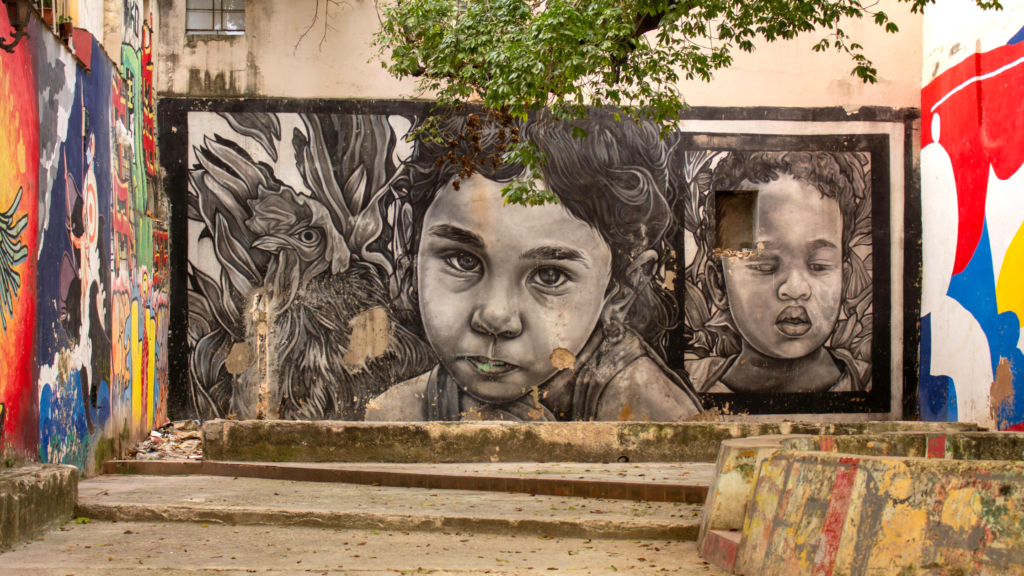
Public spaces are among the most powerful platforms for communicating messages that inspire awareness, influence behaviour, and encourage community participation. From government departments and development organizations to CSR initiatives and private brands, wall-based communication has become an effective Information, Education, and Communication (IEC) tool due to its high visibility, accessibility, and lasting impact.
However, not all wall art formats serve the same purpose. Each medium differs in terms of execution, durability, cost, aesthetics, and intended audience. Selecting the right format can significantly enhance the effectiveness of a campaign.
Comparison of Popular Wall Art Formats
| Creative Format | What It Is | Best Used For | Expected Lifespan | Relative Cost |
|---|---|---|---|---|
| Wall Painting | Hand-painted artwork created directly on walls using weather-resistant paints. | Government schemes, education, health, sanitation, agriculture, road safety, and rural outreach. | 3–7 years | Medium |
| Wall Graffiti | Contemporary artistic lettering and illustrations designed to create bold visual impact. | Youth engagement, behavioural change campaigns, urban awareness, and social causes. | 2–5 years | Medium |
| Wall Mural | Large-scale artistic compositions that narrate a story through creative illustrations. | Heritage conservation, tourism, environmental awareness, city beautification, and CSR initiatives. | 5–10 years | High |
| Wall Wrap (Vinyl Graphics) | Digitally printed vinyl graphics installed over existing walls. | Temporary campaigns, exhibitions, event branding, construction barricades, and institutional communication. | 1–5 years | Medium–High |
| Stencil Art | Artwork created using reusable templates for quick replication across multiple locations. | Public safety instructions, campaign branding, directional signage, and repetitive awareness messaging. | 2–5 years | Low |
| 3D Wall Art & Interactive Murals | Creative installations incorporating optical illusions, QR codes, augmented reality, or interactive elements. | Tourism promotion, experiential campaigns, public engagement, and digital outreach. | 3–7 years | High |
Understanding the Difference
Wall Paintings
Wall paintings are the most traditional and widely used form of public awareness communication. Created manually using durable exterior paints, they are particularly effective for long-term campaigns in rural and semi-urban areas. Their longevity and cultural familiarity make them ideal for promoting government welfare schemes, health awareness, sanitation drives, literacy campaigns, agricultural advisories, and road safety messages.
Wall Graffiti
Professionally designed wall graffiti combines bold typography, contemporary illustrations, and vibrant colours to create visually striking messages. Unlike unauthorized street graffiti, awareness graffiti is purpose-driven and resonates particularly well with younger audiences in urban environments. It is an excellent choice for behavioural change campaigns and social awareness initiatives.
Wall Murals
Murals are large-format artistic compositions that transform ordinary walls into storytelling canvases. Rather than conveying a single message, murals evoke emotions and create memorable public experiences. They are commonly used for cultural preservation, tourism promotion, environmental awareness, public art projects, and city beautification programmes.
Wall Wraps
Wall wraps consist of high-quality digitally printed vinyl graphics applied directly to wall surfaces. They offer unmatched flexibility in design, allowing the use of photographs, branding elements, multilingual content, and detailed graphics. Since they can be installed and replaced quickly, wall wraps are best suited for temporary campaigns, exhibitions, public events, institutional branding, and construction barricades.
Stencil Art
Stencil art uses pre-designed templates to reproduce identical messages across multiple locations with speed and consistency. This format is economical and particularly useful for directional signs, public safety instructions, campaign logos, cleanliness drives, and recurring awareness messages where uniformity is important.
3D Wall Art & Interactive Murals
Modern awareness campaigns increasingly incorporate interactive wall art that encourages public participation. These installations may include optical illusions, QR codes linking to digital resources, augmented reality experiences, or designated selfie points. Such formats not only attract attention but also encourage social media sharing, making them highly effective for tourism campaigns, youth engagement, and experiential public outreach.
Choosing the Right Format
The ideal wall communication format depends on your campaign objectives:
- For long-term government awareness campaigns: Wall Paintings
- For engaging urban youth and promoting behavioural change: Wall Graffiti
- For storytelling, heritage conservation, and beautification: Wall Murals
- For temporary campaigns, branding, and events: Wall Wraps
- For repetitive messaging across multiple locations: Stencil Art
- For high public engagement and digital amplification: 3D Wall Art & Interactive Murals
Effective wall communication goes beyond aesthetics—it is about delivering the right message through the right medium. A thoughtfully designed wall art strategy can transform public spaces into powerful communication assets that educate, inspire, and engage communities. In many successful IEC campaigns, combining multiple formats—such as murals for storytelling, wall paintings for sustained awareness, and interactive installations for digital engagement—creates a holistic communication ecosystem that maximizes reach, recall, and long-term social impact.
Whether the objective is promoting government schemes, encouraging behavioural change, supporting tourism, or strengthening community participation, selecting the appropriate wall art format ensures that every message leaves a lasting impression.